Ludovica Fonsato (INEAST, UDE)
“Rethinking Interdependence: Vulnerability, Agency, and Foreign Brand Responses to Chinese Economic Coercion”
22 July 2026, 12–1 pm (sharp)
Venue:
Ruhr University Bochum, building MB, room 3/126 (map)
Hybrid format: To join online via Zoom, use this link:
https://ruhr-uni-bochum.zoom-x.de/j/62345416570?pwd=GvBifWmNOeUUNjcP57PL8EHNfN8QqN.1
Meeting-ID: 623 4541 6570
Passwort: 298162
Abstract
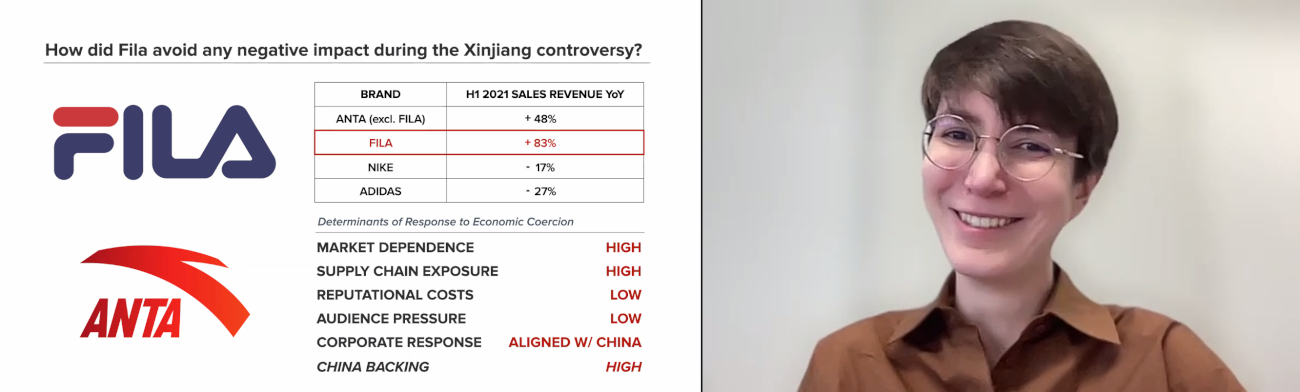
This lecture builds on the traditional theory of complex interdependence, shaped by asymmetric economic interdependence within state-state dynamics, and introduces the concept of “market interdependence,” a new brand-state framework defined by two elements: external vulnerability and internal agency. Applied to foreign brands operating in Mainland China, this framework explains how multinational corporations navigate and respond to China’s coercive episodes. Using an original vulnerability-agency matrix, brands are categorized according to their degree of economic vulnerability as well as brand autonomy and resilience, which in turn dictate their strategic corporate responses during such episodes. Through this framework and case study matrix, attendees will explore the complexity of corporate behavior and decision-making in China, along with implications for international business amid rising geopolitical and supply chain uncertainties.
About the speaker
Ludovica Fonsato, M.Sc., works at the Chair of East Asian Economic Studies, University of Duisburg-Essen. She is a China specialist with extensive experience working at the intersection of international business and East Asian political economy. She spent several years living and working in Shanghai, where she served as Brand Director, advising multinational companies on China market entry, commercial strategy, and growth, while also acting as a bridge between international stakeholders and Chinese operational teams. She has also worked with governmental trade agencies and firms navigating the opportunities and challenges of the Chinese market in a consulting capacity. Alongside her industry work, she is completing a PhD in East Asian Economics (China), focusing on China’s economic statecraft and the use of economic tools in international relations. Her work combines hands-on commercial experience in China with academic research on Chinese political economy, giving her a perspective that connects markets, policy, and geopolitics in contemporary China.